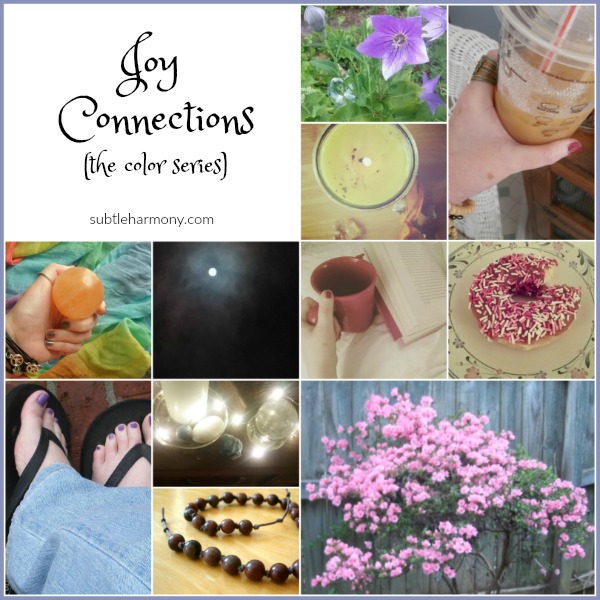
joy connections…


Joy has been on my mind a lot lately. And not only lately, to be honest – a few years ago, I realized in a deeper-than-before way that I needed to consciously and intentionally try to connect with joy as much as possible and in whatever ways work for me… I need this for my own well-being and quality of life. (Which then spills over and impacts everything in my life.)

And sometimes I need this just to simply make it through the day. (Because sometimes simply making it through the day is hard – and doing only that is enough.)

There’s a difference between happiness and joy.

You’ve probably heard that before, but do you really (really and truly) believe it and feel it?

Joy can definitely be there in a happy time.

But joy can come unexpectedly, seemingly out of the blue.

And joy can be there even in the dark and the difficult.

I remember the morning my grandmother died, a sunny August day in 1997, and my husband and I walking in our neighborhood after getting the phone call, and talking about our plans for making the trip to my hometown for the funeral, and how it felt so surreal and so sad – that this woman who was a second mother to me, caring for me and my brother as both my parents worked fulltime as I was growing up, was no longer on this earth… and at the same time, along with deep grief and sadness, there was joy too.

Unexpected. Inexplicable. But… yes, joy.

I remember the evening my father was transported by ambulance to the residential hospice facility for his last night on earth – again in August, but this time in 2013 – and after spending time with my parents in my father’s large and beautiful-but-awful room, we finally left to have a late supper, me and my husband and my brother and my nephew, sitting around the table at a fast-food restaurant while we ate chicken wings, exhausted and feeling unreal while laughing at the lovely absurdity hardness of life, but sometimes you have to laugh to keep from crying (and crying can be a good and needed thing, but sometimes the laughter is what carries us)…

And even as my heart was splitting open and breaking apart – as it had been doing for the many months leading up to that night, that weekend of my father’s passing – and even in the moments of stunned surreal silences and the moments of laughing with loved ones…

Joy was there too.

I could feel it, beneath the sad and the raw and the numbness and the unreality-of-it-all: joy, holding a spot in my heart, a beautiful aching and a wonder of how joy can co-exist with pain.

I’ve known times of such intense anxiety I couldn’t breathe and couldn’t go on, times of such depression I couldn’t get up and couldn’t see a future, times of such uncertainty I didn’t know how a path through could appear…

And then a pocket of joy would come, give me grace, help me hold on.

As I said, joy can catch us by surprise.

But along the way, I also started to realize that when we cultivate joy, when we intentionally and consciously try to connect with joy… it can be easier to notice joy and catch the joy when it shows up.

Sometimes this can be in a sort of dramatic way. But often this can be in small, even quiet, ways.

And this is why I so often talk about connection with joy, when I talk about soul nourishment and self care… Because making the decision and the choice to consciously and intentionally try to connect with joy whenever possible and in whatever ways possible – it truly can make a difference.

Will it make life perfect? No.

Will it mean there won’t be some incredibly hard stuff and difficult times? No.

But it can help.

We become more aware of those pockets of joy. We notice when there’s an undercurrent of joy beneath the pain and the hard. We open to embrace the grace that joy brings. We catch the joy, we live in that joy moment – and it can help us hold on and help us get through and help us live more fully alive.

Life can be so hard at times.

But it also has such beautiful, grace-giving joy.

Being aware of the joy that’s there truly can make a difference in life. ♥
what self care REALLY is…


A while back – maybe earlier this year, maybe before that – I started to notice is that there seems to be some confusion about what self care really is.

Self care includes any intentional actions you take to care for your physical, mental and emotional health.

It’s as simple as that, which means it doesn’t have to be complicated or expensive, and it doesn’t have to look a certain way.

(The paragraph above that’s in bold is a definition I came across in a pdf put out by the Student Affairs department at the University of Kentucky.)

Self-care will vary from person to person – and for any one person, it will be different at different times.

Self care can mean being mindful of your diet, getting some exercise, getting enough sleep. It can be going to a meet-up on a favorite topic or spending time at a church service.
It can be cuddling with a special person or pet, listening to music, taking a long hot shower, relaxing in a candle-lit room, dancing for a few minutes in your kitchen, going to a spa, painting your nails, getting your hands dirty in the soil.
It can be sitting on a beach, or under a tree, or on the floor of your bedroom as you read a book or color a mandala.

The list is endless. It can be any or all of those things – and so much more.

And some things for self care involve money…

But there are so many self-care practices and activities that do not.

Self-care is caring for YOU. It’s doing something that tends to you and what you need (on any/all levels – physically, mentally, emotionally, spiritually).

And there’s no shame involved in caring for and tending to yourself.

No one can give from an empty well, no one can run on fumes, no one can be a constant light without burning out.

Self care doesn’t have to be hard.

It doesn’t have to be luxurious.

It doesn’t have to take loads of time.

Self care can be as simple as pausing throughout your day, relaxing your shoulders, and taking a few breaths.

Self care is anything that involves “any intentional actions you take to care for your physical, mental and emotional health.”

That’s what self care really is.


behind the scenes of writing In New Harmony…

In New Harmony is my middle-grade historical novel… but it didn’t start out as a novel.

The idea that sparked what was to become In New Harmony was a little memory my mother told me. About a time when she was young, spending the night at a relative’s farm, and she’d been scared by a noise that sounded like someone breathing just outside the open window.

I turned her memory into a children’s short story, setting the story in the 1930s, the time-frame it actually happened when my mother was a small child. The title I chose for the short story was “Night Noises” – a title to reflect the differences in the noises the main character (named Bunnie in the story) experienced during her first night on the farm, compared to the noises she was accustomed to hearing at night in her home in Atlanta.

Only a few things about “Night Noises” were true-to-life when it came to my mother. Bunnie was one of her childhood nicknames. She had been frightened – and then relieved and laughing – about the noise.

But the other details and the rest of the “Night Noises” story? All fiction.

Bunnie in “Night Noises” was several years older than my mother had been at the time of this memory. My mother didn’t have a younger sister (her sisters were both older). She never lived in Atlanta and moved from there to a farm – actually, until her early teens, she lived in rural Alabama and her own family farmed a little space of land.

I revised “Night Noises” a few times… but then I realized something.

The characters wanted to stick around. And the story wanted to become longer – and go deeper.


And that’s when Night Noises started to become a novel.

I kept the main character at the older age (13) but changed the time of the story to take place in the summer of 1943 – which is when my mother was 13 herself. I changed most of the characters’ names to be different than their names in “Night Noises.” Bunnie turned into Nora, and Ellen turned into June, and Uncle John turned into Uncle Lester.
World War II became integral to the storyline, and I added the important-to-the-novel detail of an older brother who had recently been killed in battle.
And although I don’t think the word depression is ever mentioned in the novel, I added the element of Nora’s mother being deeply depressed due to her son’s death. The story of Nora’s mother – and how Nora is impacted by and deals with her mother’s depression – is a central part of the story that became In New Harmony.

I did take a few of my mother’s own experiences of life on a farm, weaving them into the story at a few places. And the setting of the novel – the imaginary New Harmony in Pike County, Alabama – is a fictional version of my mother’s small hometown community of another name. (She even drew me a little map of how it had been back then!)


But in one way, Nora’s story is the opposite of my mother’s life.

One big reason Nora and her family move to her uncle’s farm is to help out… because hiring people to help during the summer and the harvest season had become difficult. This happened because so many were now in the Army or Navy, or had moved away to work at factories necessary for the war-time effort.

For my mother’s family, this shortage of potential farm helpers was the reason they moved away from rural Alabama. Even though their house was small and their plot of field wasn’t much (my grandparents were the opposite of wealthy farmers with lots of land), my grandfather needed extra help during certain times of the year when it came to farming. More help than what he, my grandmother, and their three daughters could do by themselves.
So, when my mother was Nora’s age – or a bit older – she and her family left farming and rural Alabama.
They didn’t move to Nora’s hometown of Atlanta, but they did move to Georgia. They settled in a town – small compared to Atlanta in 1943 – but it wasn’t a rural location, and it was a town much larger than where they’d lived.

But although my mother’s move was almost the exact opposite of Nora’s, her experience of why her family moved was a big spark for part of the storyline for In New Harmony.

Some bits of the original “Night Noises” short story can still be seen in what eventually became the middle-grade novel, In New Harmony – but In New Harmony developed into quite a different story.

A story about loss, change, discovery, and family…

And ultimately, a story about love, getting through tough times, and starting anew.

(If you’d like to read In New Harmony, it’s available at Amazon (paperback as well as kindle) here and at Barnes & Noble here.)