autobiography and creating…

I’ve had a few days away from blogging during this month’s September blogging challenge as my energy has been taken up with weather and family and personal happenings.

As soon as it became obvious Hurricane Irma would mean evacuations for some of my family members – including my 88-year-old mother who lives in an assisted living facility on an island off the Atlantic coast – weather once again became a focus for me.

These days I give myself a lot of room, a lot of space, a lot of permission, a lot of grace, to release things, or back away from things, when that’s what I need to do for my self-care, my joy, my well-being, and/or my life-stuff-happenings.

Before deciding to do the blogging challenge, I gave myself lots of gentle permission to skip days if needed, or stop altogether… just taking it day-by-day for myself. And that’s what I’m doing.

Today I’m still texting and talking with family and friends who are in the path of, or being impacted by, the storm. I’m still keeping an eye on the weather news. I’m still wondering how our weather here will be effected. We don’t get hurricanes where I live, but our weather can be impacted by them (with rain, high winds, tornadoes) and sometimes we’ll end up with a tropical storm or tropical depression from a once-hurricane… and that’s looking increasingly possible for us with Irma.

What’s going on with the weather is very much on my mind and in my heart.

But I’m back to the blog (at least for today), and I’m posting something about today’s nudge/prompt:

Share something you’ve created that feels like it’s a part of your autobiography.

There are several different things that fall into this category for me – things I’ve written, things I’ve painted, things I’ve made – but the first two things that immediately jumped to my mind are two particular paintings. I couldn’t quickly find a photo of the full canvas for the first one, so I’m going to share a bit about the other one.

This one…
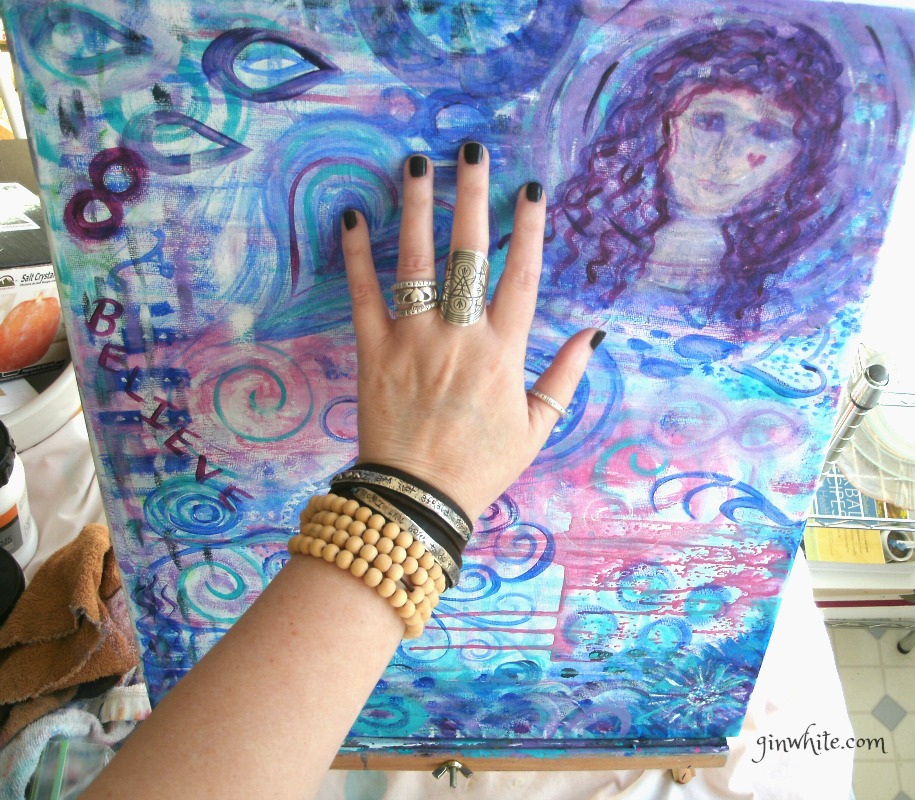
The photo was taken at the beginning of February 2015. Some of the painting was done in the weeks of January and first few days of February that year, but most of the many layers and components of the painting were painted in 2014 over a period that spanned much of that year.

That year was a year of dealing with the grief of my father’s death in 2013, and the change and grief of my mother’s move several hundred miles away and her entry into the world of an assisted living facility, and the grief of the changes in some family relationships.

That year was a year of a long physical recovery after a fall in January 2014 injured my right hand (and I’m right-handed) and my leg.

That year was a year of facing more losses-to-come as my beloved brother-in-law was diagnosed with terminal cancer. (He passed away 14 months ago.)

Painting, and especially painting on canvas as I stood in front of my table-top easel, was (as it continues to be) solace for me and joy for me… even though sometimes there were so many emotions and tears spilling from me that didn’t exactly feel joyful. Still, though, painting was where I turned. Painting was one of the main things helping me keep myself together.

There was a period of time that year when I couldn’t do much painting because of my hand injury. During that time, I tried to paint with my left hand, or tried to find some way to hold my brush for at least a little while, or sometimes just painted with my fingers.

It was a few months before I could actually wrap my fingers around a brush (or pen or pencil) again, but still I found a way to paint. And once my hand was recovered enough to hold objects like paintbrushes again, I painted more and more.

This painting is autobiographical for me because it encompasses all of that for me: the memories, the grief, the injury, the tears, the trying to heal (emotionally and physically), the processing of all the feelings, the trying to be okay in the midst of everything, the giving myself permission to paint just because I love it and no matter how it looks, and the wanting to believe that all will be well.

The paintings I do on the canvases at my table-top easel are intuitive paintings, and I just let myself do whatever comes. Whatever color seems to want to be painted. However and whichever way the brush (or my fingers or whatever) seem to want to move.

I don’t paint at the canvas for the painting to look a certain way.

I paint at the canvas for the process of it, for the doing of it, and for joy of it (even if I’m releasing some tough emotions at the time).

This painting holds the energy of that time, that year, in my life. It holds my energy. It holds my tears and my hopes.

And that’s why it feels like it’s part of my autobiography.

you will have created something…


Creativity matters. Making art matters.

It doesn’t matter if you think it’s any good or not. It doesn’t matter if you make money at it or not. It doesn’t matter if it’s something big or something small.
It’s part of soul-nourishment and self-care.

It’s part of living a fulfilling life and connecting to your inner self.

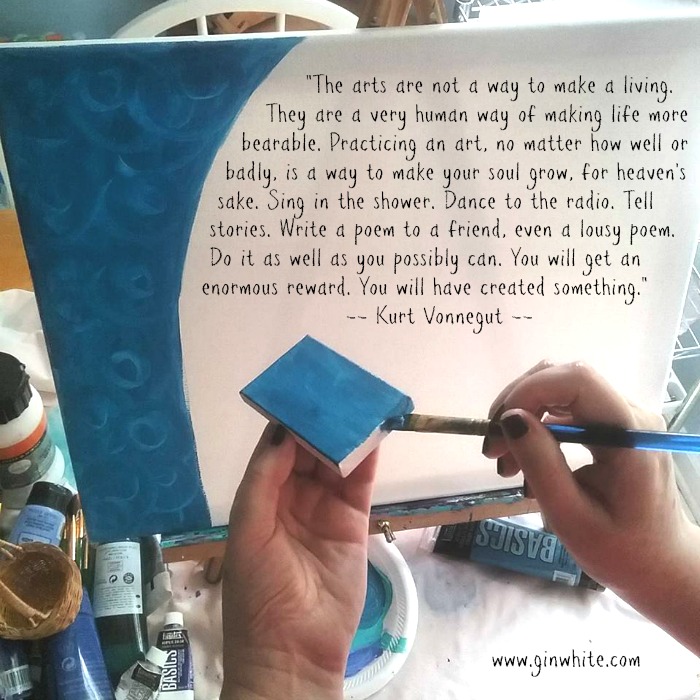
“The arts are not a way to make a living. They are a very human way of making life more bearable. Practicing an art, no matter how well or badly, is a way to make your soul grow, for heaven’s sake. Sing in the shower. Dance to the radio. Tell stories. Write a poem to a friend, even a lousy poem. Do it as well as you possibly can. You will get an enormous reward. You will have created something.”   ~Kurt Vonnegut
 

Create something. Anything.

Do it for your soul.


behind the scenes of writing In New Harmony…

In New Harmony is my middle-grade historical novel… but it didn’t start out as a novel.

The idea that sparked what was to become In New Harmony was a little memory my mother told me. About a time when she was young, spending the night at a relative’s farm, and she’d been scared by a noise that sounded like someone breathing just outside the open window.

I turned her memory into a children’s short story, setting the story in the 1930s, the time-frame it actually happened when my mother was a small child. The title I chose for the short story was “Night Noises” – a title to reflect the differences in the noises the main character (named Bunnie in the story) experienced during her first night on the farm, compared to the noises she was accustomed to hearing at night in her home in Atlanta.

Only a few things about “Night Noises” were true-to-life when it came to my mother. Bunnie was one of her childhood nicknames. She had been frightened – and then relieved and laughing – about the noise.

But the other details and the rest of the “Night Noises” story? All fiction.

Bunnie in “Night Noises” was several years older than my mother had been at the time of this memory. My mother didn’t have a younger sister (her sisters were both older). She never lived in Atlanta and moved from there to a farm – actually, until her early teens, she lived in rural Alabama and her own family farmed a little space of land.

I revised “Night Noises” a few times… but then I realized something.

The characters wanted to stick around. And the story wanted to become longer – and go deeper.


And that’s when Night Noises started to become a novel.

I kept the main character at the older age (13) but changed the time of the story to take place in the summer of 1943 – which is when my mother was 13 herself. I changed most of the characters’ names to be different than their names in “Night Noises.” Bunnie turned into Nora, and Ellen turned into June, and Uncle John turned into Uncle Lester.
World War II became integral to the storyline, and I added the important-to-the-novel detail of an older brother who had recently been killed in battle.
And although I don’t think the word depression is ever mentioned in the novel, I added the element of Nora’s mother being deeply depressed due to her son’s death. The story of Nora’s mother – and how Nora is impacted by and deals with her mother’s depression – is a central part of the story that became In New Harmony.

I did take a few of my mother’s own experiences of life on a farm, weaving them into the story at a few places. And the setting of the novel – the imaginary New Harmony in Pike County, Alabama – is a fictional version of my mother’s small hometown community of another name. (She even drew me a little map of how it had been back then!)


But in one way, Nora’s story is the opposite of my mother’s life.

One big reason Nora and her family move to her uncle’s farm is to help out… because hiring people to help during the summer and the harvest season had become difficult. This happened because so many were now in the Army or Navy, or had moved away to work at factories necessary for the war-time effort.

For my mother’s family, this shortage of potential farm helpers was the reason they moved away from rural Alabama. Even though their house was small and their plot of field wasn’t much (my grandparents were the opposite of wealthy farmers with lots of land), my grandfather needed extra help during certain times of the year when it came to farming. More help than what he, my grandmother, and their three daughters could do by themselves.
So, when my mother was Nora’s age – or a bit older – she and her family left farming and rural Alabama.
They didn’t move to Nora’s hometown of Atlanta, but they did move to Georgia. They settled in a town – small compared to Atlanta in 1943 – but it wasn’t a rural location, and it was a town much larger than where they’d lived.

But although my mother’s move was almost the exact opposite of Nora’s, her experience of why her family moved was a big spark for part of the storyline for In New Harmony.

Some bits of the original “Night Noises” short story can still be seen in what eventually became the middle-grade novel, In New Harmony – but In New Harmony developed into quite a different story.

A story about loss, change, discovery, and family…

And ultimately, a story about love, getting through tough times, and starting anew.

(If you’d like to read In New Harmony, it’s available at Amazon (paperback as well as kindle) here and at Barnes & Noble here.)